Rethinking Time: Finding the True Start of the Year in Nature.
- Ultan Cavanagh
- Feb 24
- 5 min read

Most of us make New Year’s resolutions, no matter how small. This year, I decided to become more in tune with nature. You might assume that growing up on a family farm made me naturally conscious of the environment, but that wasn’t necessarily the case. As a child, I felt deeply connected to nature, something I think is true for most kids, but as we grow up, society has a way of pushing that connection aside. The system we live in prioritises the economy above all else, reinforcing the illusion that humans are separate from nature. But we’re not. We are nature. When we harm the environment, we ultimately harm ourselves.
Even when I attended agricultural college, we were never taught about soil health or the broader ecosystem. The focus was solely on how to exploit the land for maximum profit. It wasn’t until I discovered regenerative farming that I began to see things differently. After a few years of working within that system, I started noticing its flaws, which I’ll discuss another time, and eventually transitioned to organic farming, which is far more regulated.
The training course for organic farming turned out to be the best formal education I’ve ever received in agriculture. For the first time, I was taught about soil health, ecosystems, and the importance of working with nature rather than against it. To truly succeed in organic farming, you have to be in tune with the natural world, and that’s exactly what I’ve been striving to do.
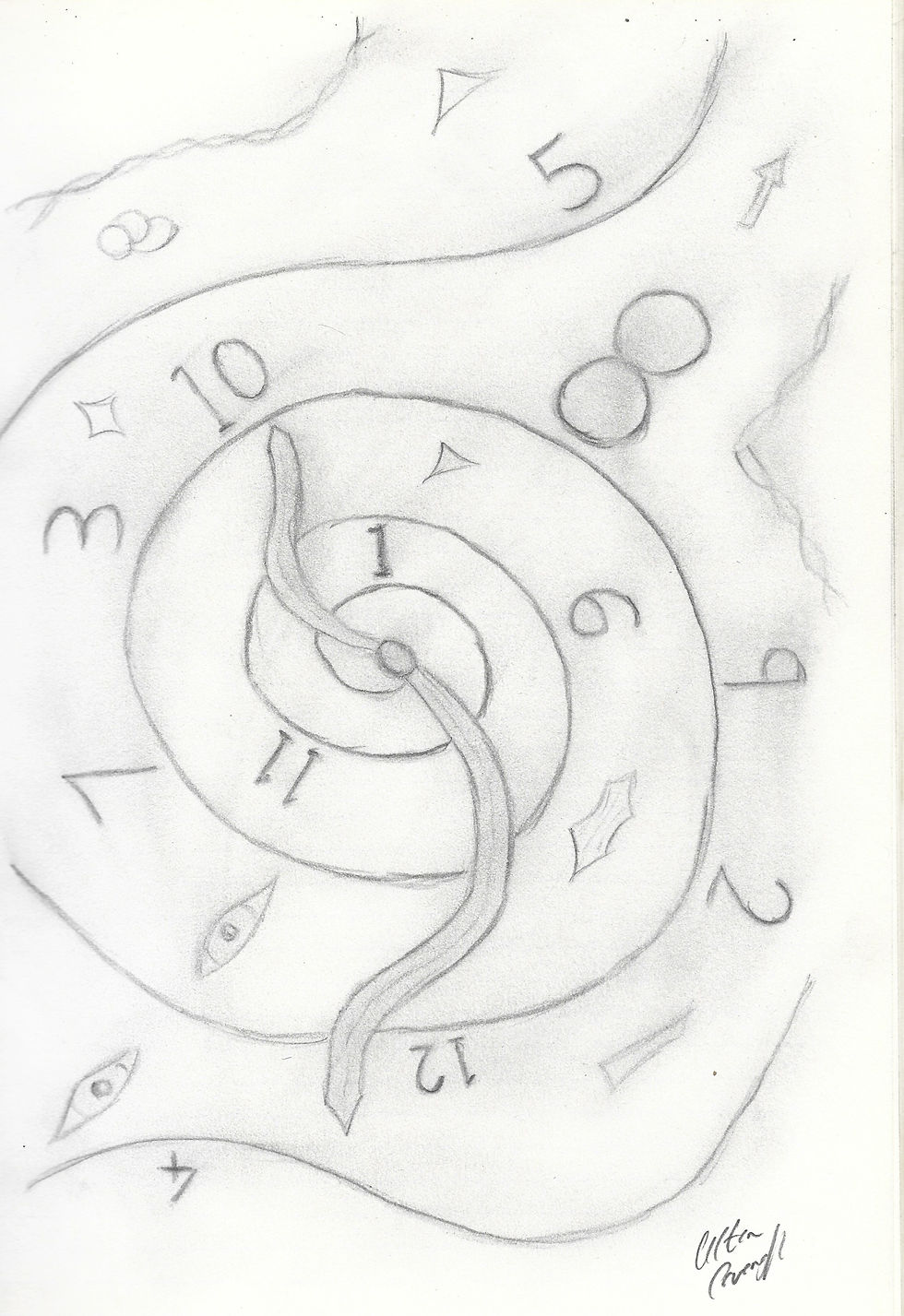
Aside from farming, I was recently given the task of writing about my concept of time, something I had never really thought much about. As I reflected, I began to wonder: does time control my life, or is it simply a way to structure my day? One realisation stood out, I often overestimate how long tasks will take, which sometimes discourages me from starting them. Not everyone thinks this way, which led me to believe that we all perceive time differently, making it a highly subjective experience. Our perception of time is shaped by our mindset, and how we think about time can shift depending on our state of mind.
The more I thought about it, the more I realized how fluid time really is. Our thoughts about the past influence our present state, but interestingly, when we recall the past, we are doing so in the present moment. This means our current emotions shape how we remember past events. The same applies to thoughts of the future, we imagine it from the perspective of now. If everything we experience happens within the present moment, does time even exist?
I found myself contemplating this while watching a cow lazily chewing cud in the shed on an unseasonably warm January day, in which the warmth encouraged a few flies out. The flies buzzed around, occasionally landing on her back. Each time, she simply flicked her tail to swat them away and continued chewing, her eyelids half-closed in contentment. A few minutes later, the same thing happened, and she responded in the same calm manner. She never grew agitated, never built-up frustration toward past flies, and never worried about future ones. She simply existed in the moment.
It made me wonder, does time exist in a cow’s world? Or in the world of any other animal, for that matter? Perhaps time is purely a human construct, something we have created that often prevents us from fully living in the present. While we obsess over clocks and schedules, animals simply be.
With that in mind, let’s take a step back and think about January 1st. Why is it considered the start of the new year? It doesn’t align with any natural event like the winter solstice, nor does it mark the true midpoint of winter, it awkwardly sits about two-thirds of the way through the season.
The answer lies with the Romans. They structured the year into 12 months to align with the phases of the moon, and they named January after Janus, the Roman god of beginnings, transitions, and duality. Janus is often depicted with two faces, one looking forward, the other looking back, symbolising his role as a guardian of both the past and the future. It was a fitting choice for the first month of the year.
So, at the end of the day, January 1st marks the new year simply because some Roman lad decided it should.
The Celts never viewed the concept of a fixed new year in the same way as modern traditions. There was no singular, specific date marking the start of the Celtic new year. Instead, they celebrated the end of the growing season at Samhain, now recognised as Halloween. This was the time when the Cailleach, the divine hag, took control of the land. Often depicted as an old woman with blue skin, white hair, and a weather-controlling staff, the Cailleach ushered in winter, bringing storms, cold winds, and snowfall.
Her connection to Imbolg (Imbolc) lies in the seasonal transition from winter to spring, a central theme in Celtic mythology. Around February 1st, the Cailleach would relinquish her power to Brigid, the goddess of fertility, healing, and renewal. This date, marking the midpoint between winter and spring, symbolised the first signs of seasonal change, such as lambing season and the lengthening of daylight. Brigid, a powerful Celtic goddess later syncretised with Saint Brigid, represented light, warmth, and inspiration, standing in direct contrast to the Cailleach’s reign over the dark and cold months.
Imbolg was celebrated with rituals like candle lighting, purification ceremonies, and offerings to Brigid, all of which signified the transition from winter’s hardships to the promise of renewal and growth. For this reason, Celts viewed Imbolg as the start of the new growing season. Rather than celebrating a new year in a linear sense, they embraced the cyclical nature of time, recognising the constant shifts in natural forces. Their myths and traditions served as a way to maintain their deep connection with nature, reinforcing the ever-changing rhythm of the seasons.
What I’ve learned from my little exploration of time is that I had been letting it control me rather than truly living in the moment. I was too focused on the future, events that may never even happen. In reality, the future is just a story we tell ourselves, shaped by our own perceptions, which may or may not be accurate. And those perceptions? They’re largely based on our interpretations of past events, which are just as unreliable.
The only things I can be absolutely certain of are this present moment and the fact that, one day, I will die.
As I observe nature here in mid-February, I see change, light, growth, and rebirth, things that weren’t visible on January 1st. To me, this feels like the true beginning of a cyclical year. Time, I’ve realised, should be a tool to structure my day, not something that dictates how I live.
Ultan Cavanagh

